Skip to content
Home
Portrait of Steinn Hauser Magnússon
Cloud Operator @ SENEC · Berlin

I'm Steinn,

a cloud operator and software engineer based in Berlin. At SENEC I run large-scale Kubernetes platforms and build the infrastructure as code, GitOps delivery and automation that keep them secure, observable and up to date.

My background is in computational physics and data science: an MSc from the University of Oslo, peer-reviewed research in computational neuroscience, and production machine-learning work. In my own time I build open-source projects end to end, like Minnumst and recipify. I work in four languages: English, Icelandic, Norwegian and German.

6+
years in cloud, software and data roles
50+
production servers operated with Ansible
10+
custom Helm charts on large-scale Kubernetes
AZ-104
Microsoft Certified: Azure Administrator Associate
MSc
computational physics, Grade A, peer-reviewed paper
01 / experience

From physics to platforms.

  1. 2023 – now
  2. 2020 – 2023
  3. 2020
  4. 2020
  5. 2016 – 2021
    Where it started: physics at the University of Oslo, a BSc in physics and astronomy and then an MSc in computational science. Education ↓
02 / selected work

Selected work.

SENEC · Cloud Operator · 2026

Automated server maintenance platform

A secure pipeline for automated maintenance updates across 50+ Ansible-managed, WireGuard-connected servers, built with strict access policies and secure networking. Hosts run a lightweight Go client for mTLS-secured maintenance checks, an API gateway schedules each host's maintenance slot, custom aptly-based repository mirrors serve the packages, and dashboards give an overview of host package lists and updates.

More about the role →
  1. Go clientmTLS maintenance checks
  2. API gatewayschedules maintenance slots
  3. aptly mirrorscustom package repositories
  4. Dashboardspackage lists and update overview
  • Go
  • mTLS
  • Ansible
  • WireGuard
  • aptly
  • Linux
Open source · Personal project

Minnumst: a self-hosted family history archive

A public archive, an editorial desk and an API that keeps every story revision, built end to end from the app to the hardened host it runs on. OpenTofu creates the Hetzner host, Ansible hardens it to the CIS benchmarks (scored with Lynis in CI), and Traefik with Authentik is the only way in. Releases are multi-arch images with an SBOM and build provenance.

Read the full story →
Minnumst's public archive in dark mode: a name search beside a photo of Grafarkirkja, a turf church in Höfðaströnd
  1. OpenTofuHetzner host, firewall, encrypted state
  2. AnsibleCIS-hardened host, scored with Lynis
  3. Traefik + AuthentikTLS edge, auth on every write
  4. The appFastAPI, React and PostgreSQL

Code on GitHub ↗

  • OpenTofu
  • Ansible
  • Docker Compose
  • Traefik
  • Authentik
  • FastAPI
  • React
  • PostgreSQL
Open source · Personal project

recipify: a verified document pipeline

Turns about 1,900 mixed recipe files (Word, PDF, spreadsheets, scans) into 524 recipes, each checked word for word against its source and traceable back to it. 100% test coverage, with a live demo built by CI.

Read the full story →
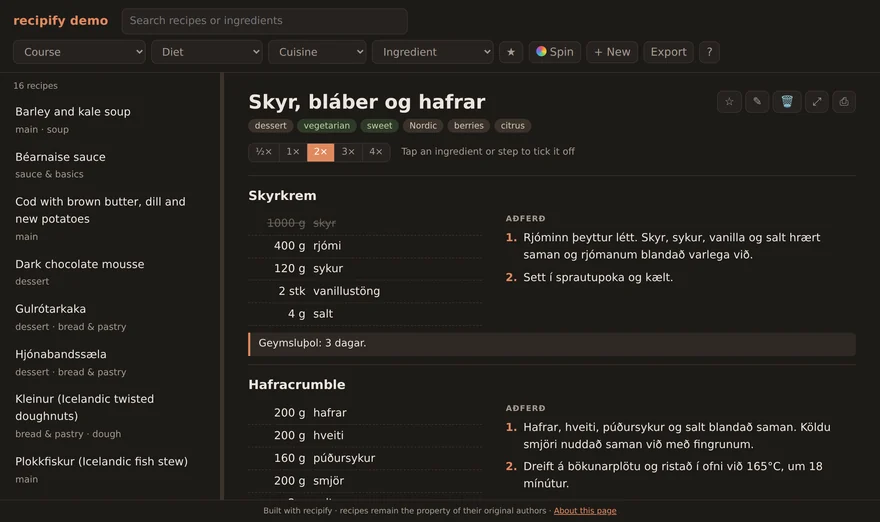
The recipify viewer: a recipe scaled to 2x with one ingredient ticked off
  1. Inventoryhash, classify and triage each file
  2. Extractpoppler, python-docx, LibreOffice
  3. Structuredeterministic rules, no rewriting
  4. Assessword-for-word check against the source
  5. Viewerone offline HTML file

Live demo ↗Code on GitHub ↗

  • Python
  • pytest
  • poppler
  • python-docx
  • GitHub Actions
Max Planck Institute · Guest Developer · 2024-2025

Cardiac artefact removal for MNE-Python

Helped develop, package and formalize a tool that removes cardiac artefacts from spinal electrophysiology data, contributed to the open-source MNE-Python library.

Pull request #13037 ↗

  • Python
  • MNE-Python
  • Signal processing
  • Open source
University of Oslo · MSc thesis & publication · 2021-2022

Predicting brain signals from neuronal networks

Evaluated the kernel and hybrid approximation methods for computing local field potentials across a range of network conditions, simulating neuronal networks in Python with LFPy. Published in PLOS Computational Biology (2022).

Paper ↗Thesis code ↗

  • Python
  • LFPy
  • Computational neuroscience
  • Simulation
03 / skills

Skills & certifications.

corethe core stack, used at an advanced level

Cloud & Infrastructure as Code

  • Azure
  • AWS
  • Terraform
  • Linux
  • Terragrunt
  • OpenTofu

Containers & GitOps

  • Kubernetes
  • Docker
  • Helm
  • ArgoCD

CI/CD & Automation

  • Git
  • GitLab CI/CD
  • GitHub Actions
  • Ansible

Observability

  • Prometheus
  • Grafana
  • Alertmanager

Networking & Security

  • WireGuard
  • mTLS
  • Azure Key Vault
  • API Management

Programming & Data

  • Python
  • Go
  • Bash
  • TypeScript
  • React
  • PostgreSQL
  • MongoDB
  • pandas
  • PySpark

Certifications

  • AZ-104
    Azure Administrator AssociateMicrosoftVerify credential ↗
  • ITIL 4
    ITIL 4 FoundationPeopleCert · IT Service Management

Languages

English
Native
Icelandic
Native
Norwegian
Fluent
German
Working proficiency
04 / education

Academic background.

2022

Publication

PLOS Computational Biology 18(8): e1010353

Hagen E, Magnusson SH, et al. "Brain signal predictions from multi-scale networks using a linearized framework."

doi.org/10.1371/journal.pcbi.1010353 ↗

August 2019 - June 2021

MSc. in Computational Science: Physics

University of Oslo, Norway

Thesis: 'Evaluating Approximate Methods for Computing Extracellular Potentials from Neuronal Networks'. Grade: A.

Specialization in computational neuroscience, simulating neuronal networks in Python with LFPy.

Spring Semester 2019

Theoretical Physics (exchange)

McGill University, Montréal, Canada
August 2016 - June 2019

BSc. in Physics and Astronomy

University of Oslo, Norway

Specialization in mathematics, statistics and computer science.

4D Space Numerical Workshop, Kobe University: simulated ionospheric effects on the NORSAT-1 satellite.

CaNoRock XVI, Andøya: simulated rocket trajectories to estimate drag coefficient and landing site.